Global Top 10 Technology Company | Threat Intelligence Team
For traditional security stack deployments, zero-day malware, Advanced Persistent Threats (APTs), and targeted phishing attacks can be especially difficult to detect and analyze.
Third party validation is critical to ensuring that suspicious threats are not dismissed as false positives and released back into the enterprise.
VMRay’s malware and phishing alert triage enriches SOAR incident data with accurate, collated reporting and increased operational threat intelligence. Prioritized IOCs and malware and phishing artifacts identified by VMRay assist in threat hunting, detection engineering, and other threat mitigation tasks.
By automating malware and phishing alert triage, VMRay provides a definitive verdict to facilitate the automation of accurate SOAR Alert blacklisting or whitelisting of true and false positives to identify legitimate threats.
Definitive verdicts support accurate, automated decisions
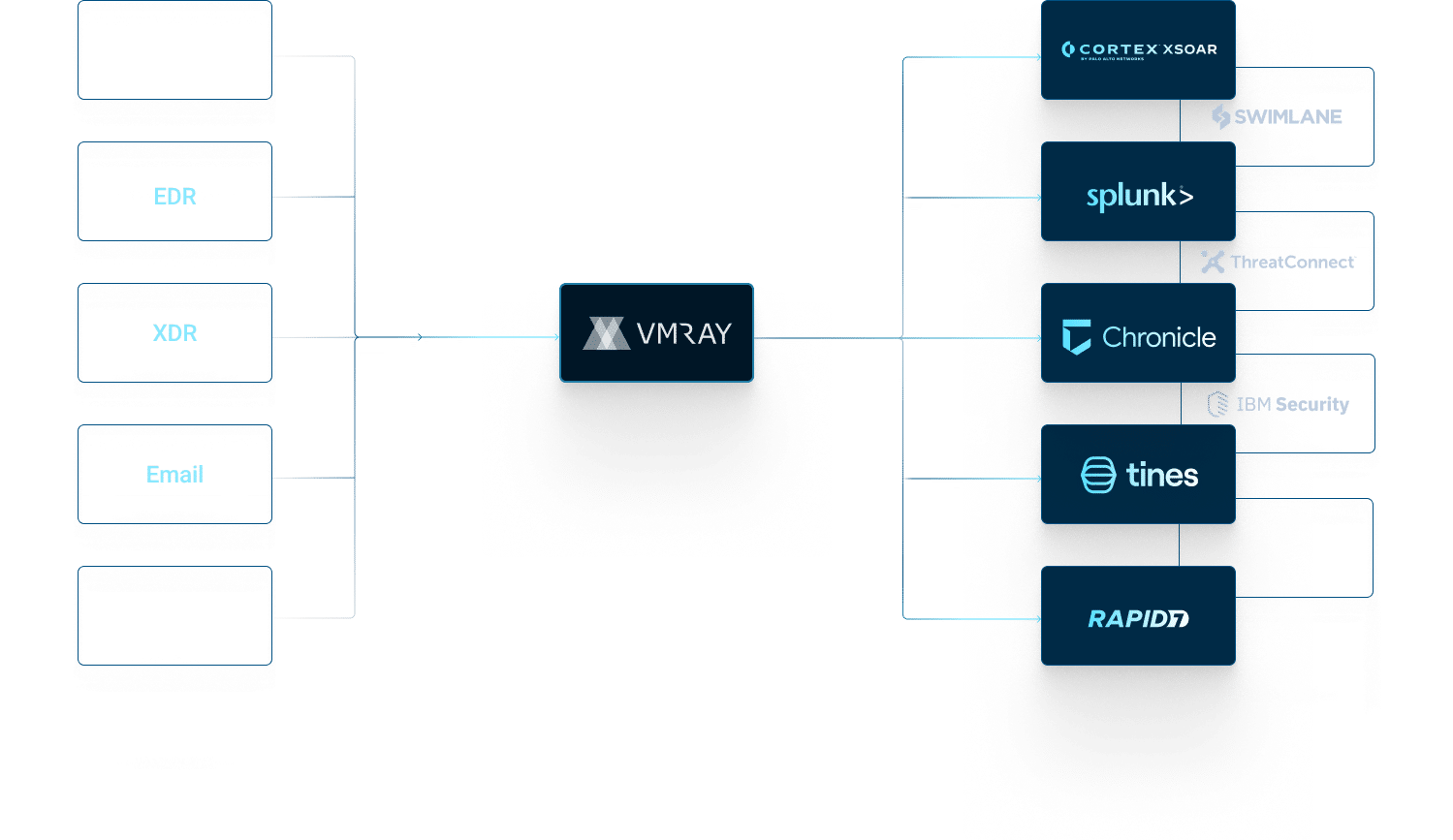
EDR and XDR solutions when combined with a SIEM or SOAR solution can correlate data across a broader spectrum of disparate security devices, including endpoint, network activity. With VMRay, definitive malware and phishing verdicts support assured, automated remediation actions.
Automated alert investigation is the process of automatically validating, enriching, and prioritizing security alerts without requiring manual analysis for every event. By integrating malware and phishing analysis into SOAR workflows, security teams can rapidly determine whether an alert represents a genuine threat, reduce investigation time, and accelerate incident response.
SOAR platforms improve malware and phishing investigations by orchestrating automated workflows that collect evidence, enrich alerts with threat intelligence, analyze suspicious files and URLs, and trigger response actions. This helps security teams investigate threats faster while reducing the burden on SOC analysts.
VMRay integrates with SOAR platforms to automatically analyze suspicious files, URLs, email attachments, and phishing indicators. The platform delivers high-confidence verdicts, behavioral analysis, threat intelligence, and actionable context directly into investigation workflows, enabling analysts to make faster and more accurate decisions.
Phishing remains one of the most common attack vectors used to deliver malware, steal credentials, and compromise business systems. Automated phishing investigation helps security teams quickly analyze suspicious emails, URLs, and attachments, identify malicious content, and prevent phishing attacks from progressing into larger security incidents.
VMRay can automatically investigate malware, phishing emails, malicious attachments, suspicious URLs, ransomware, trojans, credential theft malware, fileless threats, and other advanced attacks. The platform is designed to identify malicious behavior and provide detailed threat intelligence to support incident response.
VMRay uses advanced behavioral analysis to determine whether a file, URL, or email attachment is truly malicious. By providing high-confidence verdicts and detailed threat context, VMRay helps security teams eliminate false positives, reduce alert fatigue, and focus on the threats that matter most.
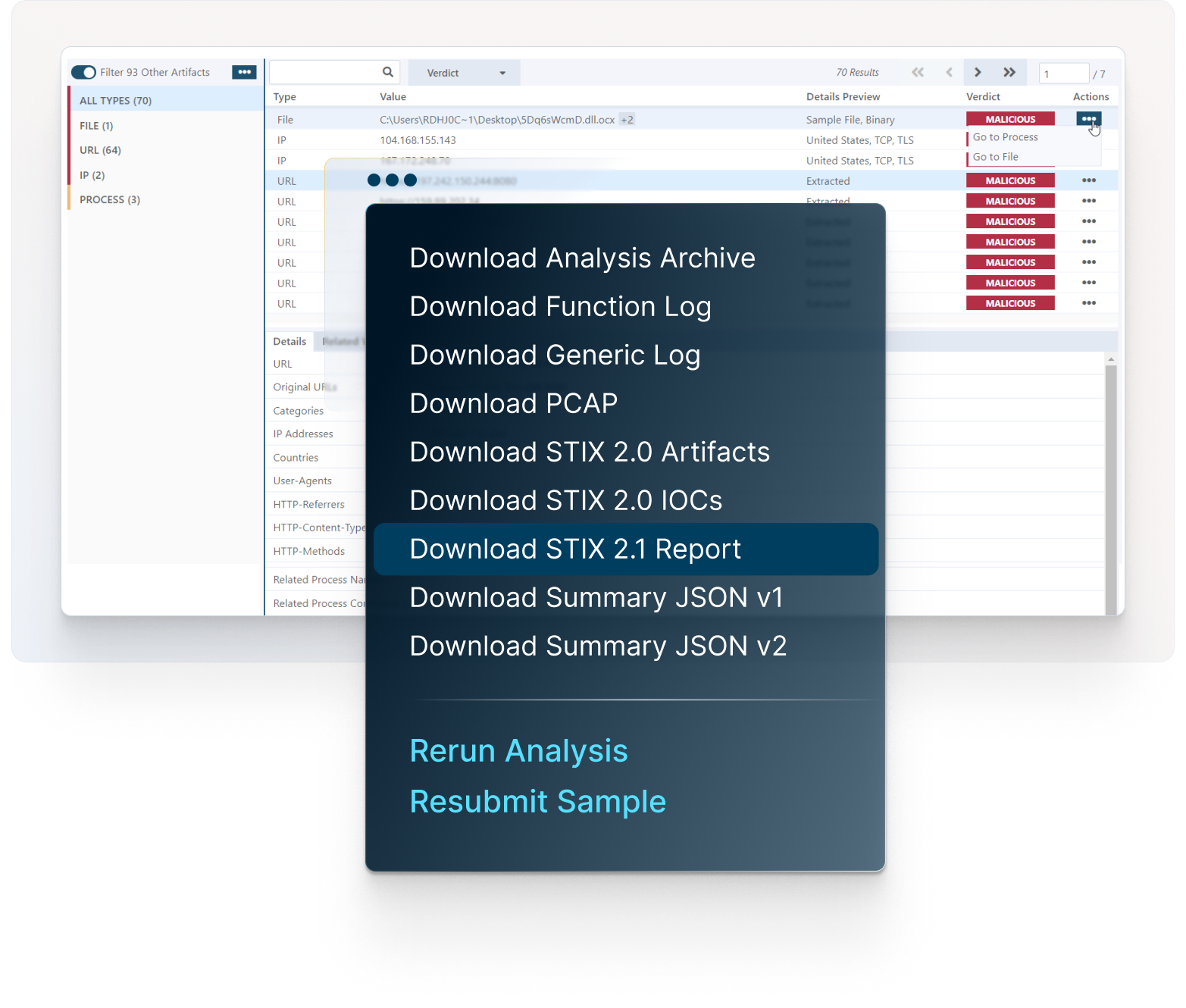
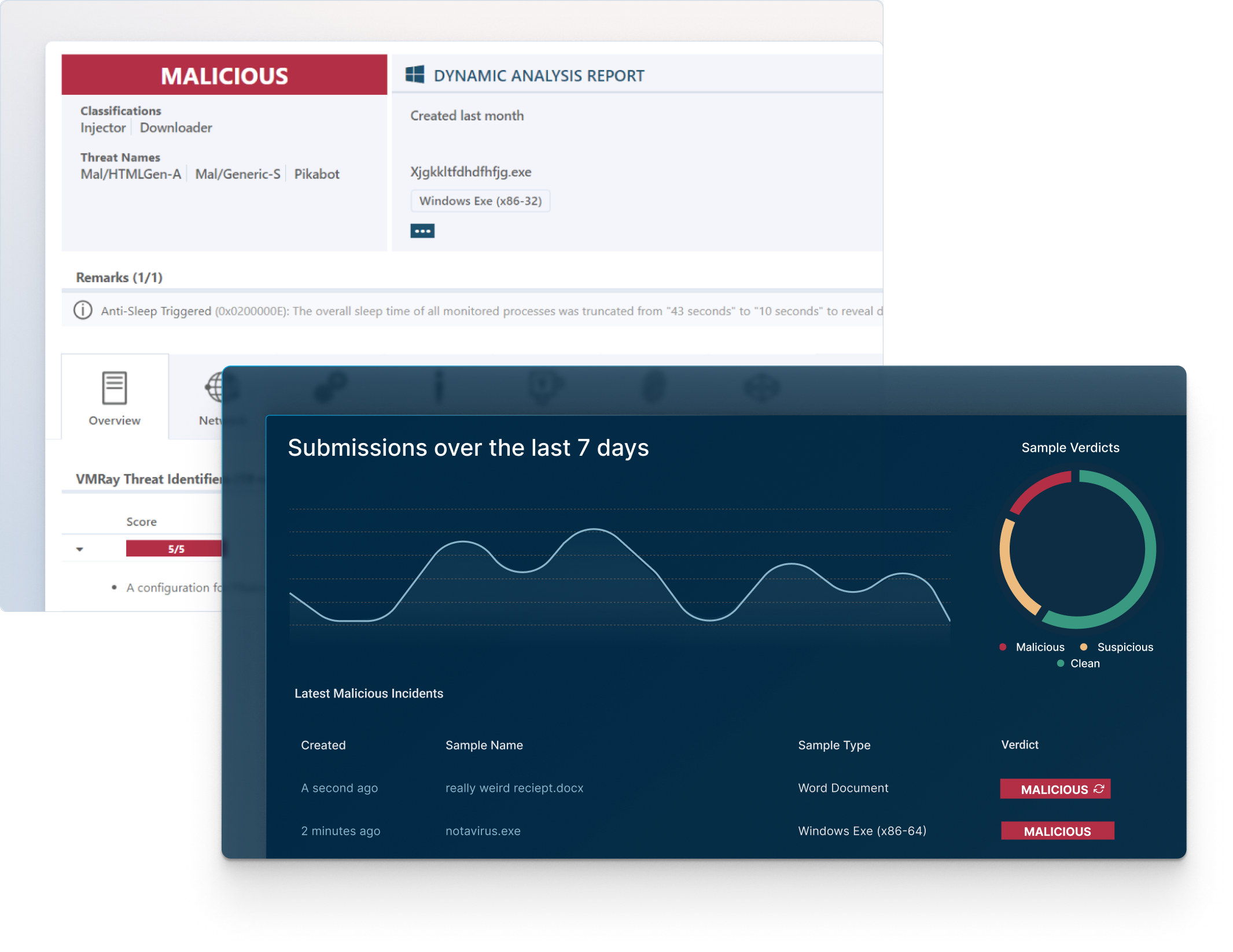
VMRay provides detailed analysis results including malware and phishing verdicts, indicators of compromise, MITRE ATT&CK mappings, threat classifications, network activity, behavioral insights, dropped files, persistence mechanisms, and threat intelligence. These insights help analysts quickly understand the nature and severity of a threat.
Automated alert investigation reduces the number of manual tasks performed by SOC analysts, accelerates alert triage, improves investigation consistency, and shortens response times. By automating repetitive analysis activities, security teams can focus on high-priority incidents and strategic security initiatives.
Yes. VMRay automatically analyzes suspicious email attachments, embedded URLs, and phishing-related artifacts to determine whether they contain malicious content. This enables security teams to rapidly validate phishing alerts and prevent users from interacting with malicious emails.
VMRay enriches investigations with actionable threat intelligence, extracted indicators, and behavioral analysis that can be used for threat hunting, incident response, detection engineering, and security operations. Analysts gain deeper visibility into attacker behavior and can respond more effectively to emerging threats.
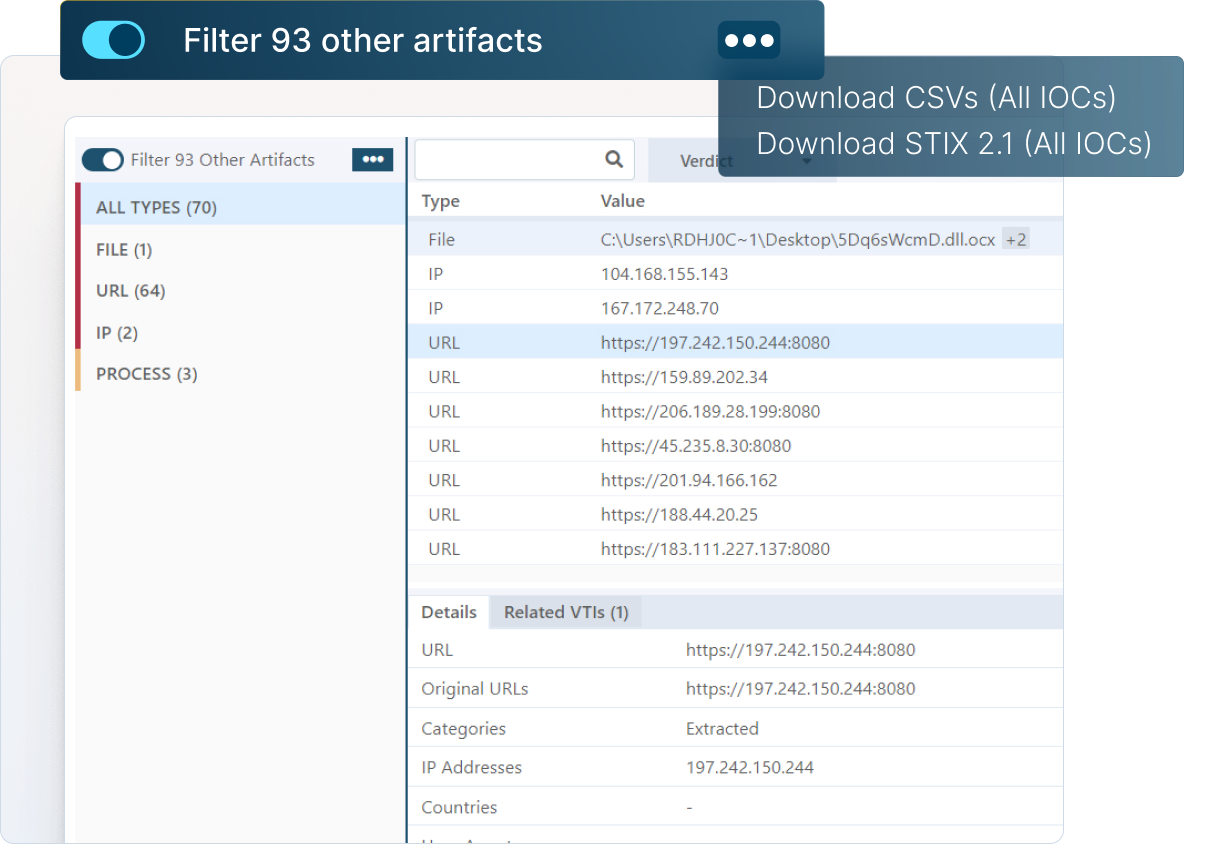
VMRay automatically extracts indicators of compromise such as malicious domains, URLs, IP addresses, file hashes, email indicators, command-and-control communications, registry changes, persistence mechanisms, and other threat artifacts. These indicators can be used to strengthen detections and accelerate remediation efforts.
VMRay integrates with leading SOAR, SIEM, XDR, EDR, email security, and threat intelligence platforms. Investigation results are automatically shared across security workflows, helping organizations streamline malware and phishing investigations while maximizing the value of their existing security investments.
Automated investigation reduces the time required to validate alerts by immediately analyzing suspicious files, URLs, and phishing artifacts as they enter the security workflow. This allows security teams to contain threats faster, prioritize critical incidents, and improve overall response efficiency.
Malware analysis focuses on understanding the behavior and capabilities of a suspicious file or URL. Alert investigation is a broader process that includes validating alerts, enriching evidence, assessing risk, prioritizing incidents, and determining the appropriate response. VMRay supports both malware analysis and automated alert investigation as part of a complete SOC workflow.